
Zurig (Febuxostat) Tablets 40 MG, 80 MG Uses Dosage Side Effects Details
Zurig Tablets (Febuxostat) 40 MG, 80 MG is a non-purine selective inhibitor of xanthine oxidase. Meanwhile, Febuxostat is chemically described as 2-[3-cyano-4-(2-methylpropoxy) phenyl]-4-methyylthiazole-5-carboxylic acid. On the other hand, Its molecular formula is C16 H16 N2 O3 S and the structural formula is:

More Useful Medications: Amaryl Tablets
Qualitative & Quantitative Composition
Mainly (Febuxostat) Tablets available for oral administration as
1- Tablets 40 MG
- Each film-coated tablet contain : Febuxostat 40 mg
2- Tablets 80 MG
- Each film-coated tablet contains : Feboxostat 80 mg
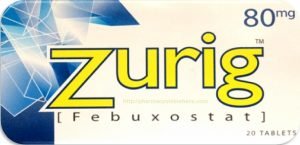
Tab Zurig Clinical Pharmacology Mechanism of Action
- This medication is a potent, non-purine, selective inhibitor of xanthine oxidase (XO) that achieves its therapeutic effect of decreasing serum uric acid by selectively inhibiting xanthine oxidase. Uric acid is the end product of purine metabolism and is generated in the cascade of hypoxanthine —->xanthine —->uric acid. Meanwhile, Both steps in the transformation are catalyzed by xanthine oxidase. On the other hand, At therapeutic concentrations it does not inhibit other enzymes involved in purine or
- pyrimidine metabolism
- Namely
- Guanine deaminase
- Hypoxanthine guanine phasphoribosyltransferase
- Orotate phosphoribosyltransferase
- Orotidine monophosphate decarboxylase or
- Purine nucleoside phosphorylase.
Special Population
Use In Renal impairment:
Following multiple doses of Zurig 80 mg of this medication in patients with mild, moderate or severe renal insufficiency. Meanwhile, the C-max of the medicine did not change, relative to subjects with normal renal function.
Use In Hepatic Impairment:
On the other hand, following multiple Zurig dosage of 80 mg febuxostat in patients with mild (Child-Pugh class A) or moderate (Child-Pugh class B) hepatic insufficiency. The C-max and AUC of tab and its metabolites did not change significantly compared to subjects with normal hepatic function.
Zurig Tablets Uses
Zurig (Febuxostat) 40 MG, 80 MG Tablets Use for the chronic management of hyperuricemia in patients with gout. Meanwhile, always consult your doctor or pharmacist before using any medicines.
Zurig Tablets Dosage And Administration
- For treatment of hyperuricemia patient with gout, it is recommended at Zurig 40 mg or 80 mg one daily.
- The recommended starting dose of this medicine is 40 mg once daily. However, For patients who do not achieve a serum uric acid (sUA) less than 6 mg per dL after 2 weeks with 40 mg, 80 mg is recommended.
- Zuring can be taken without regard to food and antacid use.
Special Population
Use For Renal Impairment:
No dose adjustment is necessary when administering febuxostat in patients with mild to moderate renal insufficiency.
Use In Hepatic Impairment:
No dose adjustment is necessary in patients with mild to moderate hepatic insufficiency.
Zurig Tablets Side Effects
Common Side Effects:
- Headache
- Diarrhea
- Nausea
- Rash
- LFT abnormalities
Uncommon Side Effects:
- Blood amylase increase
- Platelet count decrease
- Blood creatinine increase
- Hemoglobin decrease
- Blood urea increase
- LDH increase
- Triglycerides increase
- Dizziness
- Paraesthesia
- Somnolence
- Altered taste
- Abdominal pain
- Gastro-oesophageal reflux disease
- Vomiting
- Dry mouth
- Dyspepsia
- Constipation
- Frequent stool
- Flatulence
- Gastrointestinal discomfort
- Nephrolithiasis
- Hematuria
- Pollakiuria
- Dermatitis
- Urticaria
- Pruritus
- Arthralgia
- Arthritis
- Mylagia
- Muscle cramp
- Musculoskeletal pain
- Weight increase
- Increase appetite
- Hypertension
- Flushing
- Hot flush
- Fatigue
- Edema
- Influenza like syptoms
- Libido decreased
Rare Side Effects:
- Palpitation
- Renal insufficiency
- Asthenia
- Thirst
- Nervousness
- Insomnia
Contraindications
- Febuxostat is contraindicated in patients with:
- Hypersensitivity to the active substance or to any of the excipients of the product.
- Being treated with azathioprine, mecaptopurine or theophylline
- Asymptomatic hyperuricemia.
Zurig Use In Pregnancy:
Most importantly, Febuxostat should not used during pregnancy.
Use In Nursing Mother:
However, it should not be used while breast-feeding.
Warnings & Precautions
Firstly, Treatment with this medicine in patient with ischemic heart disease or congestive heart failure not recommended.
- After initiation of this medicine, an increase in gout flares is frequently observed. This increase is due to reduction in serum uric acid levels resulting in mobilization of urate from tissue deposits.In order to prevent gout flares when the medicine used in beginning, concurrent prophylactic treatment with an NSAID or colchicine is recommended.
- As with other urate lowering medicinal product, in patients in whom the rate of urate formation is greatly increased (e.g malignant disease and its treatment, Lesch-Nyhan syndrome) the absolute concentration of xanthine in urine could, in rare cases, rise sufficiently to allow deposition in the urinary tract. As there has been no experience with febuxostat, its use in these populations is not recommended.
- Laboratory assessment of liver function is recommended at for example 2 and 4 months following initiation of the tabs and periodically thereafter.
Drug Interactions
Naproxen And Other Inhibitors Of Glucuronidation;
Meanwhile, Febuxostat metabolism depends on UGT enzymes. However, Medicinal products that inhibit glucuronidation, such as NSAIDs and probenecid, could in theory affect the elimination of it. However, In healthy subjects concomitant use of febuxostat and naproxen 250 mg BID was associated with an increase in the medication exposure. On the other hand, this capsules can co-administered with naproxen being necessary.
Inducers of Glucuronidation:
Meanwhile, Potent inducers of UGT enzymes might possibly lead to increased metabolism and decreased efficacy of this tab. Therefore, Monitoring of serum uric acid therefore recommended 1-2 weeks after start of treatment with a potent inducer of glucuronidation. Conversely, cessation of treatment of an inducer might lead to increased plasma levels of febuxostat.
Overdosage Symptoms & Treatment
Meanwhile, Patient with an Zurig Tablets overdosage should managed by symptomatic and supportive care. Most importantly, immediately your doctor or visit nearby hospital in case of any overdosge.
Capsules Tablets Storage Instructions
However, always keep your medical products like injections, syrup, creams and tablets out of the reach of your small children. On the other hand, protect Zurig from direct sunlight and heat. Meanwhile, keep the medicine below 30 C room temperature.
More Medicine Information: Cefiget Tablet (Cefixime) Syrup, Suspension, Uses, Dosage, Side Effects
Zurig (Febuxostat) 40 MG, 80 MG Tablets Price In Pakistan USA India